Insights for Insurance Agencies & Brokers
Practical guidance on cybersecurity, compliance, carrier requirements, security questionnaires, and audit readiness.
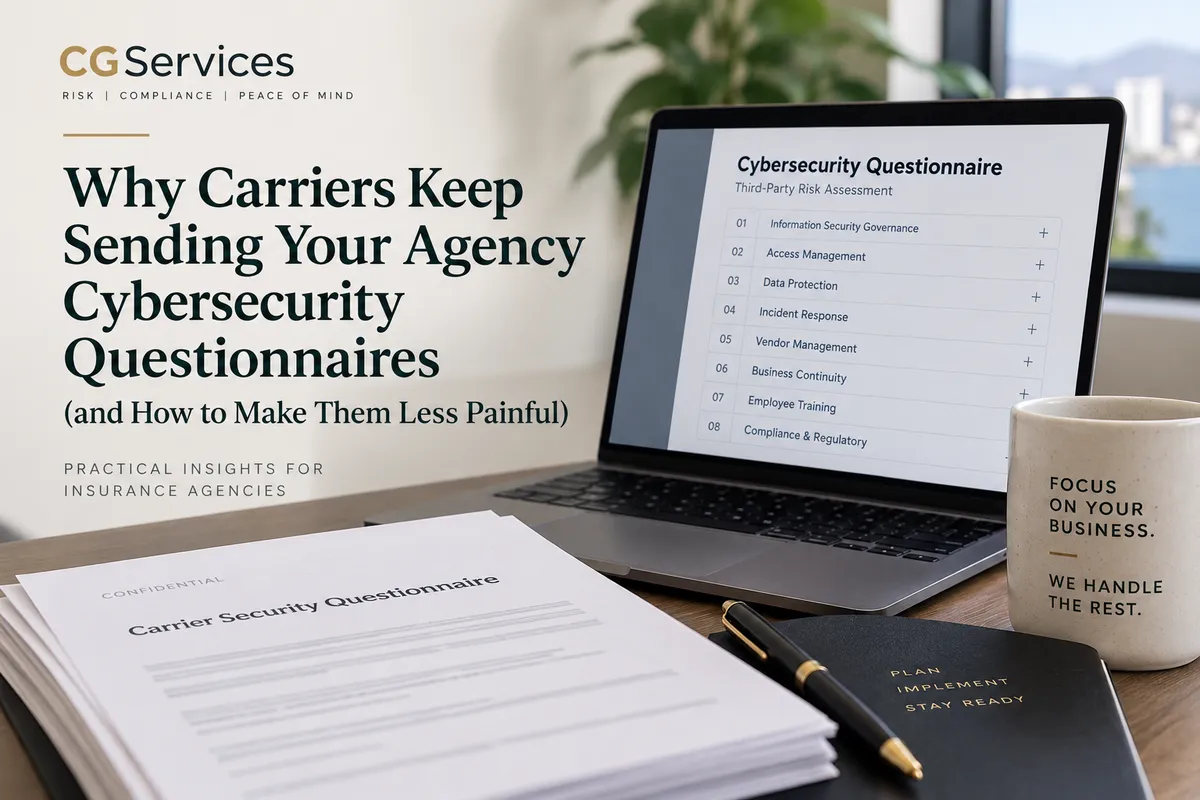
Why Carriers Keep Sending Your Agency Cybersecurity Questionnaires (and How to Make Them Less Painful)
If you run an insurance agency, you've probably seen one of these land in your inbox.
A carrier, business partner, or other third party sends over a cybersecurity questionnaire asking about multi-factor authentication, encryption, incident response, employee training, vendor management, backups, risk assessments, and security policies.
Suddenly, someone has to figure out what the questions mean, determine who has the answers, track down supporting documentation, and make sure the response accurately reflects what the agency is actually doing.
The questionnaire itself isn't necessarily the difficult part.
The difficult part is being asked to demonstrate a security program that may never have been organized with this type of review in mind.
Why Are Carriers Asking These Questions?
Insurance agencies handle sensitive customer and business information and often rely on a combination of carrier systems, agency management platforms, cloud services, email, third-party vendors, and internal technology.
That creates cybersecurity and third-party risk that organizations throughout the insurance ecosystem increasingly need to understand and manage.
As a result, agencies may encounter cybersecurity requirements through carrier relationships, security reviews, contractual obligations, cyber-insurance applications and renewals, regulatory requirements, or other third-party assessments.
The exact questions vary, but the underlying objective is usually similar: understand how the agency protects information and whether appropriate security practices are actually in place.
And increasingly, simply answering "Yes" may not be enough.
Don't Guess Your Way Through the Questionnaire
Some security questionnaires look deceptively simple.
Do you require multi-factor authentication?
Do you maintain an incident response plan?
Do you perform periodic risk assessments?
Do you review user access?
Do you maintain a vendor management process?
Yes. No. N/A.
The problem is that a "Yes" can lead to another question:
Can you provide evidence?
If the agency says it conducts annual security awareness training, there should be something demonstrating that the training occurred.
If the agency says access is periodically reviewed, there should be evidence of those reviews.
If an incident response plan exists, it should reflect how the organization would actually respond to an incident.
That's why the safest approach isn't to answer based on what you think is happening. Verify the control, understand how it operates, and determine what documentation supports the response.
If something isn't in place, identify the gap rather than trying to make the answer fit the questionnaire.
What Should Your Agency Have Ready?
You don't need to wait until a questionnaire arrives to start organizing your security program.
A few areas are worth addressing ahead of time.
1. Keep Your Security Documentation Organized
Policies and procedures should reflect how the agency actually operates.
Depending on your environment and requirements, this may include:
Information security policies
Incident response procedures
Risk assessments
Vendor management documentation
Employee security training records
Other supporting security documentation
Having the documents is only part of the equation. They should remain current and reflect the security practices actually being followed.
2. Know Where Your Evidence Is
A policy says what should happen.
Evidence helps demonstrate that it actually happened.
Training records, access reviews, security reports, tickets, system configurations, meeting records, and other artifacts may all become relevant during a review.
Keeping that evidence organized throughout the year is considerably easier than trying to reconstruct it when a deadline arrives.
3. Understand Your Vendors' Responsibilities
Your agency probably depends heavily on third-party platforms and cloud services.
Understand which security responsibilities belong to those providers and maintain the security documentation they make available when appropriate.
Their documentation, however, doesn't replace evidence for controls that remain your agency's responsibility.
4. Work With Your IT Provider on Technical Controls
Questions involving MFA, endpoint protection, backups, encryption, vulnerability management, email security, and other technical safeguards may require input from your MSP, internal IT team, or technology vendors.
If a technical gap is identified, work with the appropriate provider to understand and implement the necessary changes.
5. Know Your Gaps Before Someone Else Finds Them
Finding a weakness before a review gives you time to address it properly.
Finding it while you're three days away from a questionnaire deadline is considerably less pleasant.
Regularly assessing your security program helps identify missing controls, outdated documentation, incomplete evidence, and unresolved risks before they become urgent requests.
The Real Goal Is to Make the Next Review Easier
Getting through one cybersecurity questionnaire shouldn't mean putting everything back in a folder and forgetting about it until the next request arrives.
A better approach is to use the process to build a repeatable security and compliance program.
Policies stay current. Evidence is collected as activities occur. Risks and remediation items are tracked. Vendor information stays organized. Responsibilities are understood.
Then, when another carrier or business partner asks about your cybersecurity practices, you're not starting from zero.
You already have much of what you need.
You Don't Have to Manage All of This Internally
For a small or midsize insurance agency, maintaining a dedicated internal governance, risk, and compliance function may not make sense.
That's where Managed GRC can help.
CGServices works with insurance agencies and brokers to manage the ongoing governance, risk, and compliance work behind their cybersecurity programs.
That can include:
Security policies and procedures
Risk assessments
Evidence management
Vendor and third-party risk
Security questionnaires
Control monitoring
Remediation tracking
Audit and carrier review readiness
Ongoing compliance activities
We don't replace your IT team or MSP.
When a technical gap is identified, we help document what needs to be addressed, coordinate with the appropriate parties, track progress, and review the supporting evidence. Your internal IT team, MSP, or technology provider handles the technical implementation.
The result is a security and compliance program that stays organized throughout the year, not one that has to be reconstructed every time a questionnaire arrives.
Have a Security Questionnaire Sitting on Your Desk?
If you're dealing with a carrier security review, questionnaire, or other cybersecurity requirement, CGServices can help you understand what's being requested, identify gaps, organize the supporting documentation, and manage the process.